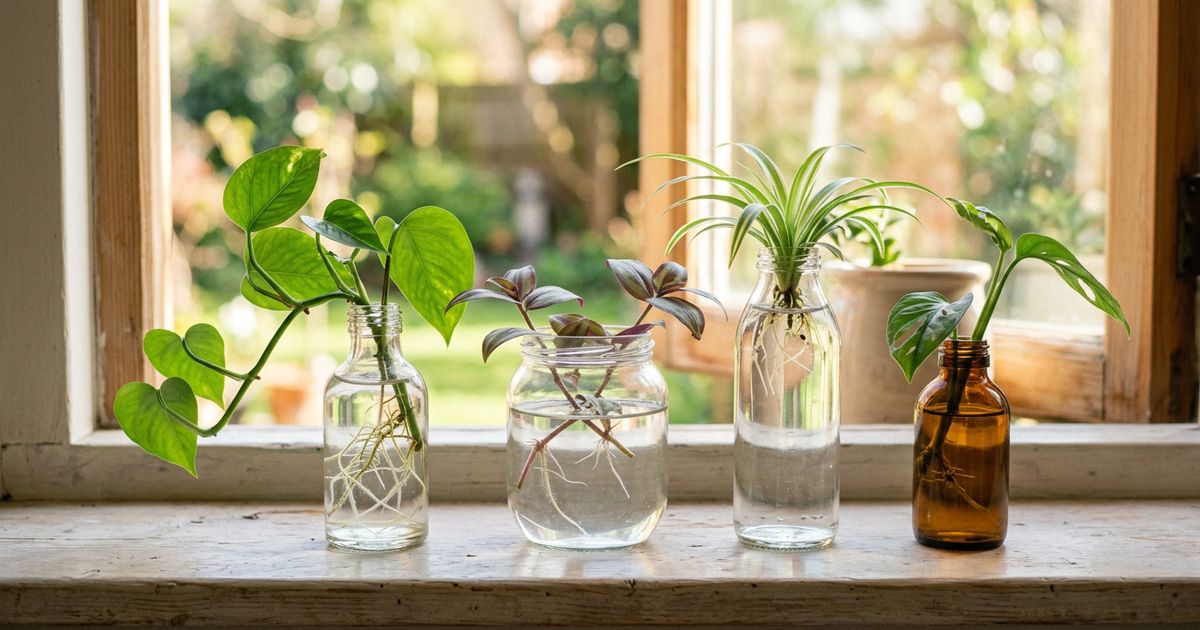
Propagating a plant sounds like advanced gardening, and for lots of houseplants it’s literally popping a stem in a glass of water and waiting. No compost, no rooting hormone, no special skill. A glass, some light and two weeks.
It works because many tropical plants can grow roots straight from the stem. In the wild it’s how they cling on to a tree trunk, or sprout again when a branch falls on damp ground. A glass of water on a windowsill strikes them as a perfectly reasonable situation.
Which plants root in water and which don’t
This is the part that saves you a lot of disappointment, because not all of them will.
They do really well: pothos, tradescantia, arrowhead plant, ivy, spider plant and monstera. They all have soft stems with clear nodes, which is exactly what you need.
They don’t: succulents and cacti, which rot before they root because they’re built for precisely the opposite. Nor do woody-stemmed plants, which need compost and patience on a different scale.
And one people ask about a lot: the poinsettia. It’s not one that does well in water. When you cut it, it oozes a white latex that clouds the glass, and the cutting nearly always ends up rotting. We cover it in full here. If you want to try, it does much better in damp compost, once the cut has stopped oozing latex.
Did you know? Roots don’t sprout from just anywhere on the stem, but from the nodes: those little bumps where the leaves and branches come out. That’s where the plant keeps the cells that can turn into roots. Which is why you cut just below a node — and why a piece of stem with no node at all will never root.
How to do it, step by step
1. Choose a healthy stem ten or fifteen centimetres long, with two or three leaves and at least a couple of nodes. Better from a part that’s growing well than from a sorry-looking straggler.
2. Cut just below a node, with clean scissors. A clean cut heals better and is less likely to get infected.
3. Strip the lower leaves, the ones that would end up underwater. A leaf under the water rots and spoils the whole glass.
4. Into the glass, with enough water to cover the node but not reach the remaining leaves.
5. Light, yes; direct sun, no. A window that doesn’t face south, or a metre back from one. Direct sun warms the water and turns it green with algae.
6. Change the water every three or four days. It’s the step most people skip, and the one that sees off the most cuttings.
Why the stem rots
If the end goes soft and brown and the water smells, it’s nearly always one of these three:
Old water. Standing water runs out of oxygen and bacteria do the rest. Changing it every few days almost completely prevents it.
A submerged leaf. It decomposes and contaminates the glass. Check none of them are touching the water.
Too much stem underwater. Covering one or two nodes is plenty. Sink half the cutting and you’ve doubled the surface that can rot.
If it happens, all is not lost: cut above the soft part with clean scissors, fresh water, and start again.
When to move it into compost (and why not to wait)
Roots appear in one or two weeks. The temptation is to leave it in the glass until it’s got a full head of hair, but the opposite is better: pot it up when the roots are two or three fingers long.
The reason is that water roots and soil roots aren’t the same. The ones that form in a glass are finer and more fragile, adapted to a place where oxygen and water are everywhere. The bigger they get in water, the harder it is for the plant to rebuild them for life in compost — and that’s the moment when most cuttings are lost, not before.
When you pot it up: a small pot, loose compost and slightly more generous watering for the first two weeks while it settles in.
Or leave it in water for good
That’s an option too, and it looks lovely. A pothos can live for years in a glass jar on the windowsill.
Just two things: you still need to change the water, and because there are no nutrients in water, every month or six weeks it’ll appreciate a drop — one drop — of very diluted liquid feed. Without it, it won’t die, but it’ll stay small and pale.
Start today: cut a pothos stem just below a node and leave it in a glass on the windowsill. In two weeks you’ll have roots, and in a month a plant to give away.
Frequently asked questions
Which houseplants root best in water?
Pothos, tradescantia, arrowhead plant, ivy, spider plant and monstera. They all have soft stems and clear nodes, which is what roots need to sprout.
Can you root poinsettia cuttings in water?
It’s not one that does well in water: when cut, it oozes a white latex that clouds the glass and the cutting usually rots. It does much better in damp compost, once the cut has stopped oozing latex.
How long do the roots take to appear?
Usually one or two weeks, depending on the plant and the temperature. It’s best to pot it up when the roots are two or three fingers long, rather than waiting for a full head of hair.
Where should I cut the stem so it roots?
Just below a node, the bump where the leaves come out: that’s where the plant keeps the cells that can turn into roots. A piece of stem with no node at all won’t root.
Why does my cutting rot in water?
Nearly always because of old water, a leaf left underwater that decomposes, or too much stem in the glass. Change the water every three or four days, strip the lower leaves and cover only one or two nodes.
Can it stay in water for good?
Yes, and it looks lovely. You still need to change the water and, because water has no nutrients, add a drop of very diluted liquid feed every month or six weeks so it doesn’t go pale.