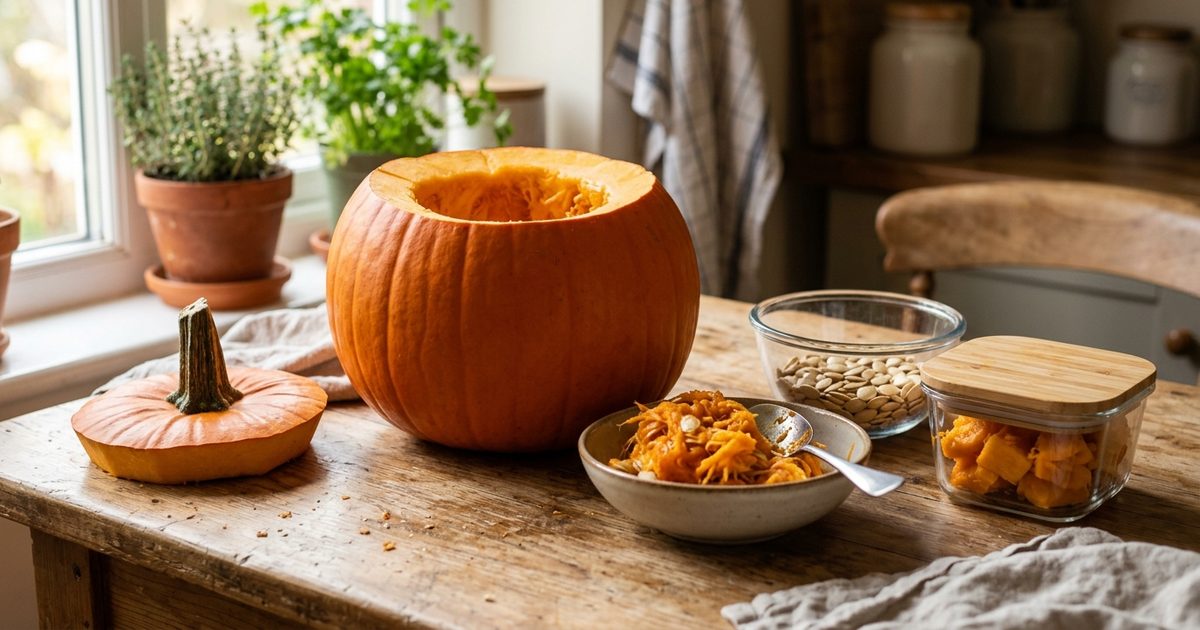
Yes, you can use it — just not the way you’d expect. The part that’s really worth having is the seeds. The flesh has a rather obvious snag: it’s the wall of the pumpkin, so you either carve it or you eat it. You can’t have both.
Every year on 1 November it’s the same story: an enormous pumpkin sitting on the table, already a bit soft, taking up space, weighing a ton and too sad to throw away. This is what you can do with it — and what you can’t, which is the part nobody tends to mention.
A carving pumpkin isn’t an eating pumpkin
Let’s start here, because it saves a disappointment. The big orange Halloween pumpkins are bred for size, shape and thin walls: their job is to look good and let you hollow them out with a knife. Flavour never came into it.
Their flesh tends to be stringy, watery and pretty bland. You can eat it; it just isn’t very nice. If you’ve ever made soup with one and it came out watery, it wasn’t your fault.
The ones that cook well are different: butternut squash, onion squash (also sold as red kuri), and small pumpkins in general. A rule of thumb at the greengrocer’s: pick it up, and if it feels heavy for its size, it’s got more flesh and less air. Those are the ones for cooking.
The seeds: the bit that’s really worth it
Here there’s good news, and it applies to any pumpkin, carving ones included: the seeds always turn out well.
Separating them from the stringy guts is, by a long way, the most unpleasant job of the afternoon: it’s slippery, it clings to your fingers and it just won’t come apart. The shortcut is to tip the lot into a bowl of water and let it sort itself out — the guts float, the seeds sink, and all you have to do is watch.
Then dry them well with a tea towel, and don’t rush this bit: a damp seed comes out of the oven chewy, a dry one comes out crunchy. That’s the whole secret. There isn’t another one.
After that, a little oil, some salt, and into the oven at 180°C for fifteen to twenty minutes, giving them a stir halfway. When they start to turn golden, they’re done.
They cost nothing, they make the whole house smell wonderful and they disappear on their own. Put them in a jar where you can see them and they’ll last two days — that’s the see-it-eat-it trick working in your favour for once, and a great stand-in when it’s time to swap a snack.
Did you know? The bitterness in this plant family has a name: cucurbitacins. The varieties we eat have been bred for centuries to be free of them, but a report by the Nordic Council of Ministers notes that a cultivar can occasionally get that ability back. Hence a simple rule: if a pumpkin, a courgette or a cucumber tastes really bitter, don’t eat it — and don’t save seed from it, because the bitterness is passed on.
Hollowing out a pumpkin isn’t taking out the flesh
There’s a mix-up here worth clearing up, because it changes the whole plan.
When you hollow out a pumpkin for carving, what comes out is the seeds and the stringy guts. The good flesh doesn’t come out with them: the flesh is the wall, and it has to stay where it is, because it’s what holds the pumpkin up and what you’re going to carve. Take it out and you’ve got nothing left to carve.
So with a single pumpkin you can’t have both. You either carve it, or you eat it.
What you can keep is this: to carve the face comfortably you need to thin the wall from the inside to two or three centimetres, especially where you’re going to cut. Those scrapings are proper flesh, and they can go into a container and into the fridge — straight away, before the pumpkin starts its big night.
Because the wall that stays put spends the evening and the night open, at room temperature, with a lit candle inside, handled by half the household and often sitting on the doorstep or out on the balcony. However much it pains you, that’s no longer something you put in a soup.
And remember what we said earlier: the flesh of a carving pumpkin isn’t much good anyway. If what you actually want is to eat pumpkin, you’re better off carving the big orange one and buying a small butternut squash to cook.
And no, it won’t turn into cabello de ángel
If you’ve ever had cabello de ángel — literally ‘angel’s hair’, the candied filling inside Spanish pastries like ensaimadas — you might wonder whether your pumpkin could end up as that. It can’t. It’s made from a different gourd altogether, known in Spain as cidra or cidra cayote, whose flesh falls apart into fine threads when it’s cooked, like hair. Hence the name. Those threads are what get candied with sugar.
A carving pumpkin won’t do it. Its flesh doesn’t have those fibres, so all you’ll get is sweet orange mush.
And if you can’t face doing any of this
That’s fine too. Putting the pumpkin in the food-waste bin or on the compost once it’s done its job isn’t waste: a decoration gets used and then it’s over, like a Christmas tree.
Using every last bit isn’t a moral duty. If you fancy roasting the seeds, that’s ten minutes well spent; if not, you’ve already had from it what you bought it for. No guilt handed out here.
Start today: when you open it up to carve, put the seeds aside in a bowl. It’s the one step you can’t do later, and it’s exactly the one that’s worth it.
Frequently asked questions
Can you eat a Halloween pumpkin?
You can. But the big orange carving pumpkins are bred for size, shape and thin walls, not flavour, so their flesh tends to be stringy, watery and bland. The ones that cook well are different: butternut squash, onion squash and, in general, small pumpkins that feel heavy for their size.
How do you roast pumpkin seeds?
Separate them from the stringy guts, dry them well with a tea towel, toss them in a little oil and salt and roast them at 180°C for fifteen to twenty minutes, stirring halfway, until they start to turn golden. To separate them, a bowl of water helps: the guts float and the seeds sink.
Can you carve a pumpkin and cook it as well?
Not fully with the same pumpkin. Hollowing it out removes the seeds and the stringy guts, not the flesh: the flesh is the wall, and it has to stay so there’s something to carve. All you can save are the scrapings from thinning the wall on the inside, put in the fridge straight away. The wall that stays spends the night open with a candle inside, and that doesn’t go back in the kitchen.
Why does my pumpkin taste bitter?
Because of cucurbitacins, the bitter compounds in this plant family. The varieties we eat are bred to be free of them, but a cultivar can occasionally get that ability back. The practical rule is simple: if a pumpkin, a courgette or a cucumber tastes really bitter, don’t eat it.
Is cabello de ángel made from Halloween pumpkins?
No. That Spanish candied filling is made from a different gourd, known in Spain as cidra or cidra cayote, whose flesh falls apart into fine, hair-like threads when cooked — hence the name, ‘angel’s hair’. A carving pumpkin won’t do it.