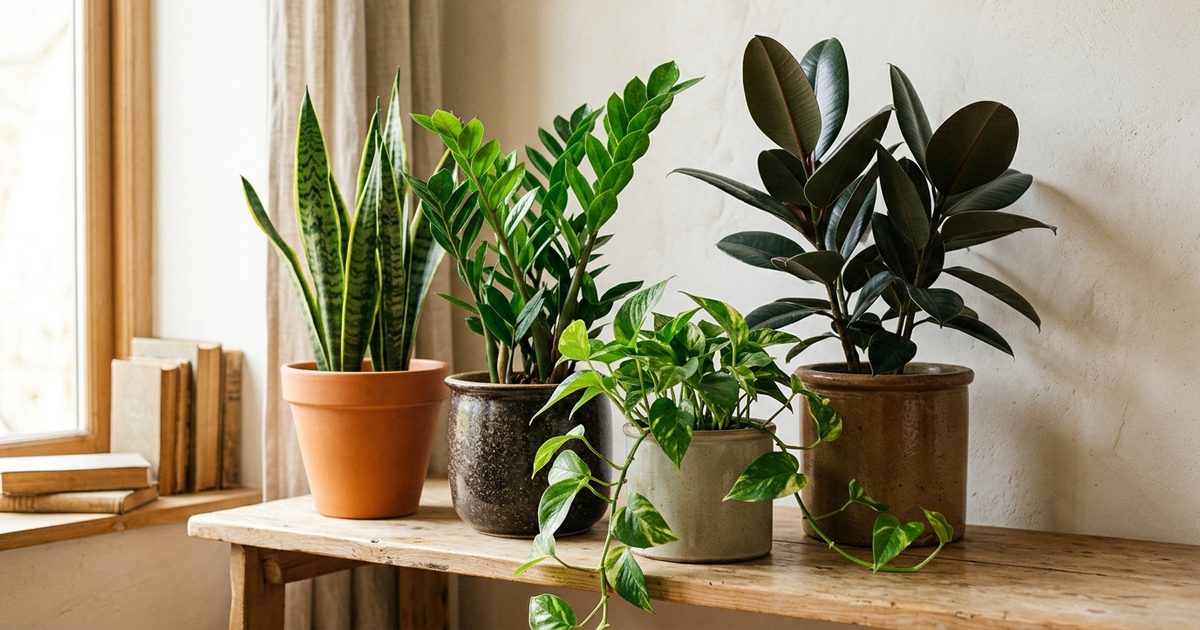
If you’ve killed plants before, the problem is hardly ever the plant: it’s that you chose a demanding one for the spot and the pace of life you’ve got. These twelve cope with neglect, low light and erratic watering better than almost any other houseplant.
The table is there to look things up, not to learn by heart. Save it and check it whenever you’re not sure.
| Plant | Water | Light | Difficulty |
|---|---|---|---|
| Snake plant (mother-in-law’s tongue) | Every 15-20 days | Low light, tolerates shade | Very easy |
| ZZ plant (Zamioculcas) | Every 2-3 weeks | Low to medium | Very easy |
| Pothos (devil’s ivy) | When the soil feels dry | Shade to indirect light | Very easy |
| Spider plant (Chlorophytum) | Moderate, letting it dry out between waterings | Indirect | Very easy |
| Aloe vera | Every 2-3 weeks | Direct or very bright | Easy |
| Jade plant (Crassula) | Every 2-3 weeks | Very bright | Easy |
| Peace lily (Spathiphyllum) | Often, without waterlogging | Soft, indirect | Easy |
| Tradescantia (inch plant) | Moderate | Bright indirect | Easy |
| Arrowhead plant (Syngonium) | Moderate | Indirect | Easy |
| Ivy | Moderate; likes humidity | Indirect | Easy |
| Rubber plant (Ficus elastica) | When the top layer is dry | Bright indirect | Easy |
| Corn plant (Dracaena) | Moderate, letting it dry out | Indirect, tolerates low light | Easy |
If you had to start with just one, make it the snake plant: it copes with shade, needs watering every two or three weeks and forgives almost anything. And if what you want is to fill the house without spending, pothos and spider plants multiply on their own when you pop a stem in water.
Two warnings that apply to all twelve. First: more houseplants die from too much water than from neglect. If in doubt, don’t water. Second: ‘indirect light’ doesn’t mean gloom — it means a bright room where the sun doesn’t hit the leaves full on.
Start today: look at where you want to put it and how much light reaches that spot. Choose the plant afterwards, not the other way round.