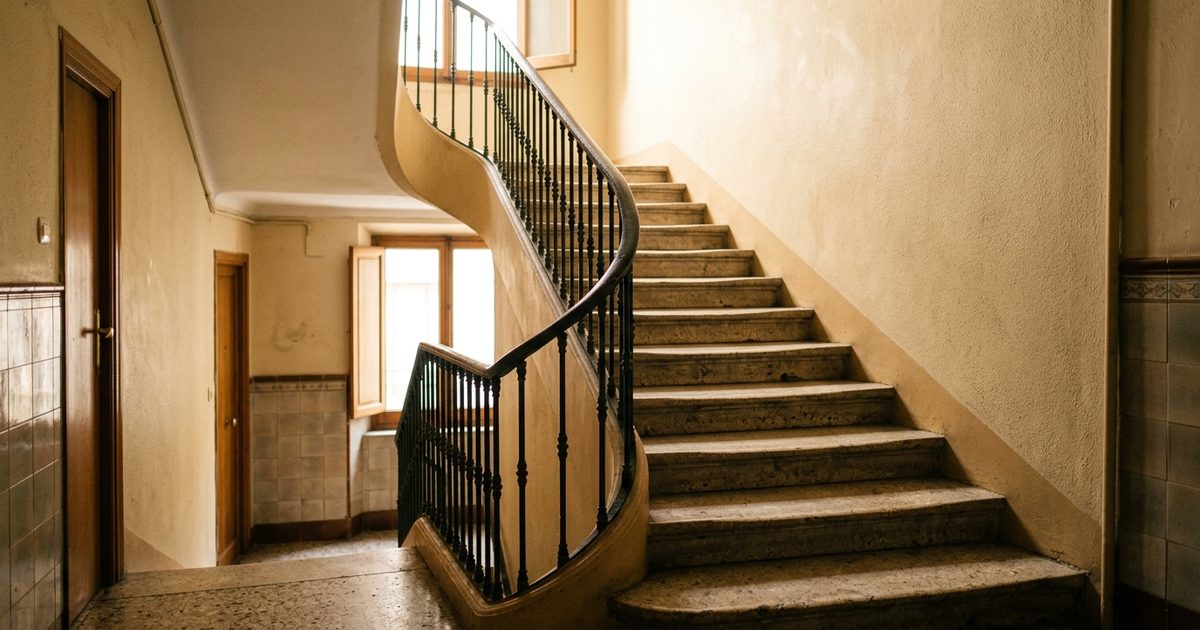
Of all the ‘move more’ advice out there, this is the only piece that asks for no time. No kit, no gym, no getting up earlier. You were going to that front door anyway; all that changes is which button you don’t press.
That’s why it works when the rest fail.
Why it lasts longer than a resolution
Most new habits fall apart over one silly thing: you have to remember. Not this one, because the reminder is already built into your life — you reach the entrance, you see the lift, and there’s the decision, every day, without anyone having to remind you.
It’s exactly the habit-stacking mechanism, but without having to set anything up: the anchor came factory-fitted.
And it has another advantage: it doesn’t compete with anything. A thirty-minute walk has to be squeezed into a day that’s already full. The stairs take up no space, because the slot for getting home was already booked.
Did you know? Going up is far harder than coming down. Going up, you lift your whole body against gravity; coming down, gravity does the work and your legs just brake. That’s why one flight up is so much more tiring than one flight down — and why walking down is the easy version to start with.
The mistake of promising ‘always’
‘From today, never the lift again’ lasts a week. You get back with the shopping, or in a hurry, or shattered, you take it once, and that’s the end of the resolution — the usual ‘well, I’ve broken it now’.
It works much better the other way round, by choosing a small version that can’t be broken:
Always walk down, walk up when you can. Walking down takes hardly any effort, and it’s already half your trips.
The last two floors. Lift to the sixth, then walk up to the eighth. It sounds like cheating and it’s exactly the opposite: it’s the only version that survives living on the eighth floor.
Only when you’re travelling light. With the shopping, the lift. Hands free, the stairs. The rule decides for you and there’s no bargaining with yourself.
If you live on the first floor, this isn’t for you
Let’s be honest: if you live on the first or second floor you already use the stairs, and this adds nothing new.
Your version is outside the house: the station, the car park, the office, the shopping centre. Those are your stairs, and it works the same way, because the reminder comes built in there too.
When your knees have something to say
Going down puts more load on the knees than going up, even though it takes less effort. If you feel discomfort coming down, flip the rule: walk up and take the lift down. It’s the combination almost nobody uses, and it makes complete sense.
And the usual: if there’s pain that won’t go away, or a condition involved, that needs to be seen by a professional. A blog post doesn’t replace anyone.
What not to expect from this
It’s worth being clear, because this advice is sometimes sold as if it were a training plan, and it isn’t.
Climbing four floors a day doesn’t replace moving properly. It doesn’t compete with a half-hour walk and it isn’t going to transform anything.
What it is: the cheapest way there is to get some movement into your day without negotiating with your diary. And that, kept up for years, pays off far more than an ambitious resolution abandoned in February.
Start today: next time you leave home, walk down. Just down. That’s all.
Frequently asked questions
Does taking the stairs count as exercise?
It counts as movement, and that’s the point: it’s activity that takes up no time in your day, because you were going home anyway. What it isn’t is a training plan: a few floors a day don’t replace going for a walk or moving properly.
Is it better to go up or down?
Going up takes much more effort, because you lift your whole body against gravity; coming down, gravity does the work and your legs just brake. That’s why walking down is the easy version to start with, and it’s already half your trips.
What if I live on the eighth floor?
Don’t set out to climb all eight. Take the lift to the sixth and walk the last two. It sounds like cheating and it’s the opposite: it’s the only version that survives on the eighth floor, and surviving is the whole point.
My knees hurt coming down — what should I do?
Flip the rule: walk up and take the lift down. Going down puts more load on the knees than going up, even though it takes less effort. And if the pain doesn’t go away, have a professional look at it.
Is it any use if I live on the first floor?
At home it won’t add much, because you already use those stairs. Yours are outside: the station, the car park, the office, the shopping centre. It works the same way.
How often do I need to do it for it to count?
There’s no number. A habit you keep up for two years pays off more than a perfect one abandoned in February, so choose the version you can’t fail: always walk down, or only when your hands are free.